Pretty easy to accept, in my opinion. What's interesting to me is that in the same class, near the end of the term, we covered a few heterodox economic traditions that all raised specifically different objections against neoclassical economics. However, though these objections were different in detail from each other, they all generally pointed out the ridiculous nature of the neoclassical assumption of the isolated individual. To think that we are all born with neat preferences and valuations that remain unaffected by our surroundings; to think that human beings function as objective estimators of utility -- Karl Marx, Thorstein Veblen, and many other heterodox economists laughed at these suppositions.
Their reasoning? People are defined by their environment: they're either confined to the viewpoints of their social class (Marx) or social animals that thrived on "emulation" (Veblen), or they're just generally irrational beings that looked to environmental cues to determine the value of certain goods (behavioral economics).
Once again, the same issue pops up: individuals are beholden, at least in part, to society. Individuals don't actually exist individually.
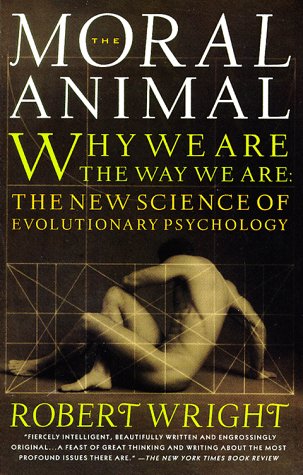
Then, of course, Wright's The Moral Animal. This is a clear message: human beings evolved and are therefore born with certain psychological desires, for instance companionship, sex, etc. More importantly, the survival of the individual doesn't matter so much as the continued survival of a certain gene. Evolution is a process that cares very little about the individual and breeds humans with impulses that may not benefit themselves so much as they benefit the survival of their viable offspring. Again, individuals? Not so important or so powerful, really.
Finally, the last in this lis
 t: Malcolm Gladwell's Outliers, which I just finished a few days ago. Gladwell writes with one clear thesis in all of his books; in Outliers, his thesis is that the success stories of any field are never self-made. They always benefit from cultural heritage, or social conditions, or lucky circumstances -- something that gives them an advantage over others. No one ever rises to the top by himself.
So I am almost forced to the conclusion, after these few months of learning virtually the same lesson over and over again, that individual agents are not as important as we usually make them out to be. We owe a lot to our parents, to our backgrounds, to whatever it is we've been exposed to and influenced by since birth. This doesn't come as a complete shock to me -- I was never convinced that I was somehow detached from my surroundings.
But still, as a subjective being, I can really only say that I know my own thoughts and my own judgments. My own perceptions will always be the most important to me, because they're the only ones I will ever be able to trust. So it's troubling in a sense to think that I'm really worth nothing -- that in the great big game of evolution and scientific process and economics and whatever else, I'm just a pawn to be pushed around by cultural trends.