Showing posts with label human nature. Show all posts

Saturday, May 01, 2010

New: experiences.

Spoke too soon.

Always make me question my fundamental nature.

Instead, though: Shouldn't I just realize that I have no fundamental nature?
(Or no tangibly fundamental nature, that is.)

Something chameleonic about the state of things that excites/unnerves me. Lately have noticed how much I hate obligation, expectation, repetition. Wrestling with the idea that maybe I'm not so good at people -- at the real activity of people, that is: following through, patience, similar arguments couched in similar terms, "working" through issues.

Beginnings better than ends.

Ought I devote energy to fixing this about myself? Again: fundamental nature, or lack of maturation? Which, which?

Sunday, April 25, 2010

ENTP.

I'm always wary of the MBTI because I wonder why it takes a test for me to understand the answers I already gave.

Nevertheless, I spent more an hour today trying to figure out why the type I presumed I was (ENFP) didn't really make any sense. And then I realized it was wrong.

So here it goes for who I suppose I "actually" am, now:
ENTPs are usually verbally as well as cerebrally quick, and generally love to argue--both for its own sake, and to show off their often-impressive skills. They tend to have a perverse sense of humor as well, and enjoy playing devil's advocate. They sometimes confuse, even inadvertently hurt, those who don't understand or accept the concept of argument as a sport.

ENTPs are basically optimists, but in spite of this (perhaps because of it?), they tend to become extremely petulant about small setbacks and inconveniences. (Major setbacks they tend to regard as challenges, and tackle with determination.) ENTPs have little patience with those they consider wrongheaded or unintelligent, and show little restraint in demonstrating this. However, they do tend to be extremely genial, if not charming, when not being harassed by life in general.

In terms of their relationships with others, ENTPs are capable of bonding very closely and, initially, suddenly, with their loved ones. . . . ENTPs are also good at acquiring friends who are as clever and entertaining as they are. Aside from those two areas, ENTPs tend to be oblivious of the rest of humanity, except as an audience -- good, bad, or potential.
Source: Typelogic

The ENTP personality type is sometimes referred to the "Lawyer" type. The ENTP "lawyer" quickly and accurately understands a situation, and objectively and logically acts upon the situation. Their Thinking side makes their actions and decisions based on an objective list of rules or laws.

Under stress, the ENTP may lose their ability to generate possibilities, and become obsessed with minor details. These details may seem to be extremely important to the ENTP, but in reality are usually not important to the big picture.

With their thinking tied to the myriad possibilities they see in the world, they act swiftly and decisively upon those angles, choices and combinations scarcely noticed by other types, but through which they can build whole new frameworks or completely redefine an existing external situation in such a way that it appears new, revitalized and once again full of promise. Sameness, stasis, conservatism - even daily routine - can be loathsome to fervent ENTPs, whose drive is always to be into something new, different and full of fresh possibilities.

ENTP people measure their success by their “aha” moments, by the sense of satisfaction which comes as they spread their newly written maps before them and contemplate the new adventure, design, investigation or conquest which has now become their road ahead. What has gone before, previous achievements, ways of living - even people met along the way - are often now forgotten or considered passé, mere steps along a path which has now brought a new frontier to be exploited for its gifts.

Without a solid thinking function, the ENTP can easily discount or fail to notice the essential ethics of social and interpersonal relationship, often considering themselves “above” or untouched by such limiting values and often discounting the possibility that their actions might be or hurtful or seen as unethical by others. It is not that the one sided ENTP is deliberately hurtful, but simply ignorant of the effects which can flow from their often compulsive need for change or need to show how clever or individual they are.
Source: Personality Page

For ENTPs, falling out of love, which may not always occur, results when their vision of the relationship does not square with reality. Sometimes they will select someone who offers stability and comfort and ENTPs later will become bored with the stability. When scorned, ENTPs use their powerful and broadreaching analysis to explain the reasons why the relationship was not good in the first place; additionally, they may become competitive with their former partner and work hard to win. ENTPs do not like to lose at anything they undertake.
Source: Some random site

All right, enough of this nonsense.

Saturday, December 26, 2009

Individuals, societies.

Trends in (my) recent thinking: I took a class on the history of economic thought last semester and was basically taught to ignore the Lewis & Clark view of scientific progress as inaccurate and too close to hero worship to really be taken seriously. That is, the classic way we're taught to think of famous figures in any field -- as geniuses who acted as individual trailblazers to lead us to enlightenment and greater knowledge -- ignores the fact these great scientists/theorists had to rely on their fellow researchers, the ideas being batted around their fields at the time, and a whole slew of other factors. The story of scientific progress isn't one of revolutionaries who discovered elusive truths; in fact, it's more realistically one of communal effort and cooperative problem-solving.

Pretty easy to accept, in my opinion. What's interesting to me is that in the same class, near the end of the term, we covered a few heterodox economic traditions that all raised specifically different objections against neoclassical economics. However, though these objections were different in detail from each other, they all generally pointed out the ridiculous nature of the neoclassical assumption of the isolated individual. To think that we are all born with neat preferences and valuations that remain unaffected by our surroundings; to think that human beings function as objective estimators of utility -- Karl Marx, Thorstein Veblen, and many other heterodox economists laughed at these suppositions.

Their reasoning? People are defined by their environment: they're either confined to the viewpoints of their social class (Marx) or social animals that thrived on "emulation" (Veblen), or they're just generally irrational beings that looked to environmental cues to determine the value of certain goods (behavioral economics).

Once again, the same issue pops up: individuals are beholden, at least in part, to society. Individuals don't actually exist individually.

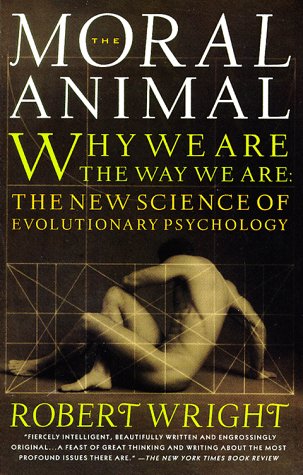
Then, of course, Wright's The Moral Animal. This is a clear message: human beings evolved and are therefore born with certain psychological desires, for instance companionship, sex, etc. More importantly, the survival of the individual doesn't matter so much as the continued survival of a certain gene. Evolution is a process that cares very little about the individual and breeds humans with impulses that may not benefit themselves so much as they benefit the survival of their viable offspring. Again, individuals? Not so important or so powerful, really.

Finally, the last in this list: Malcolm Gladwell's Outliers, which I just finished a few days ago. Gladwell writes with one clear thesis in all of his books; in Outliers, his thesis is that the success stories of any field are never self-made. They always benefit from cultural heritage, or social conditions, or lucky circumstances -- something that gives them an advantage over others. No one ever rises to the top by himself.

So I am almost forced to the conclusion, after these few months of learning virtually the same lesson over and over again, that individual agents are not as important as we usually make them out to be. We owe a lot to our parents, to our backgrounds, to whatever it is we've been exposed to and influenced by since birth. This doesn't come as a complete shock to me -- I was never convinced that I was somehow detached from my surroundings.

But still, as a subjective being, I can really only say that I know my own thoughts and my own judgments. My own perceptions will always be the most important to me, because they're the only ones I will ever be able to trust. So it's troubling in a sense to think that I'm really worth nothing -- that in the great big game of evolution and scientific process and economics and whatever else, I'm just a pawn to be pushed around by cultural trends.

Wednesday, December 16, 2009

Moral Animals?


Recently read Robert Wright's 1994 bestseller The Moral Animal. I'm wary of being too eager about it because I know someone better-versed (more well-versed?) in evolutionary psychology than I am will tell me that Wright's ideas are outdated, that the theories he covers have since been torn apart by new findings -- or maybe that he's a misogynistic pig for even questioning the benefits of a monogamous society, etc.?

Regardless of what someone out there thinks, I find The Moral Animal to be reasonably written and Wright to be a pretty even-headed guy. And regardless of whether Wright is right (gross pun) about every single implication of evolutionary psychology, the question of how evolutionary psychology should inform our understanding of morality is without a doubt an important one.

This is a fluffy post that really has nothing to say for itself other than: I really enjoyed this book. It was well-written and thought-provoking. Also I'm thinking about reading The Evolution of God, which is Wright's latest installment.

Tuesday, October 27, 2009

Human weakness.

The other day I decided that human need was often mistaken for human weakness.

I've since changed my mind.

Human weakness is often excused as human need. In reality, humans suck. They're pathetic little things with insecurities and imperfections, and no, this doesn't make them more "human" or more "intricate." It just makes them more sucky.

They have no clue what the fuck they're doing. They have no resolve, no self-knowledge, no understanding of what in the world they want or how they're going to get it. They rationalize all their decisions without any regard for the wisdom they would otherwise pretend to understand.

I'm angry because I'm disappointed. I realized that I only know a handful of sane people, and that I could very well be a victim of the same idiocy that I've witnessed so strongly these past few days. Everyone is so selfishly foolish, hopefully and hopelessly romantic. The cynics were right! We suck. Congrats, everyone.

Wednesday, October 07, 2009

Never will I ever--.

--hate anyone ever again.

It's draining. "Enervating," as they say (a word that doesn't seem to mean itself -- as I was reminded this past weekend). I've done it. I'm over it. The truth I want to believe is: if we could dig ourselves out of moral stupidity and somehow bring ourselves to full empathy, we could never hate. It would be impossible, because we're all too human. (Read: // we're all // too human, not we're //all too // human.) But supposing that isn't actually true, I still think I could do it, as a personal project! (Personal projects = awesome. Obviously.)

Friday, October 02, 2009

Things go (wrong).

I'm becoming disillusioned.

(Originally I titled this post "Bad things happen." -- but then I realized. That's not what I mean. It's not only that shit happens spontaneously, that you turn a corner and suddenly someone's throwing a tomato at you. Obviously that happens too, and it sucks. But more than that, aside from that, independent of that, I'm talking about the phenomenon in which great things turn sour, fruit over-ripens and spoils, the best thing warps into the worst. What I mean is: the transition from the illusion to the disillusion. I mean it very specifically: the letdown, the disappointment, the stark contrast between what you expect and what you get.)

(Or perhaps I should say that I'm becoming more disillusioned, because honestly and realistically I was never all that expectant of anything great. The contemporary age loves tragedy and feeds on melodrama. We're taught that shit happens, that it's artistic, that it's painful and great to fall upon the thorns of life, that blood proves we're alive. We're supposed to suffer actively. We're supposed to relish it.)

In any case, even that notion has turned stale. I've experienced no great travesties, nothing even close to martyrdom. But what I have experienced is something closer to malaise. In the past few months every profound concept has crumbled beneath the weight of triviality. You need so much faith to believe in intangibles: trust, love, gratitude, compassion. They exist to validate everyday interactions, to convince us that yes, something does occur beneath our words. (Our words are supposed to mean something. They're supposed to stand in place of deep understanding. They convey subjective truth -- blahblahblahbutreally? is that really how it works?)

Maybe this is just the age at which I now find myself. All my friends are undergoing painful transitions into the mess we call adulthood, especially in terms of romance. I'm just overwhelmed by all the ways that (ha!) things go wrong. It's difficult -- unspeakably so -- to understand another human being well enough to achieve acceptance. It's impossible to realize the full humanity of someone else.

And even after that, it takes effort to maintain a connection. It's just so much, and we're all so tired, and wouldn't it be easier -- wouldn't it? -- just to fall asleep, to tumble casually over edge of the precipice, to stumble into living and to pretend that we couldn't have predicted our mistakes? We could be blameless. We didn't know better.

(But all along, we did know better. We had to have known. At some point we looked around us and we saw, but it was too much to prevent. And in the end the failure won't be something glorious and tragic, but rather something shriveling, something altogether inevitable/inescapable (not a bang but a whimper), and it'll just prove, once again, the full truth of the matter: that things go wrong, that they have and will and always, always will.)

Sunday, September 20, 2009

What I think sometimes.

  1. I can reduce some people to the lack of a certain key characteristic -- I think, therefore, that they are defined by their deficiency, a human with a gaping hole.
  2. Others, who appear to be well-adjusted, I believe to have been coddled by their environment, growth and self-knowledge stifled by habitual comfort. I find these people limited and delusional.
I don't think I know anyone who doesn't fit into these two categories.
...Leaving me with the inevitability of oversimplification, or condescension.

Tuesday, August 25, 2009

The limits of neuroscience?

I was in neuroscience class today.

There exists a particular reaction to the existence of neuroscience -- a shock, I guess, that scientists can actually understand certain parts of human nature in the form of action potentials and neurotransmitters. It exists as a giddiness of sorts, almost an assumption of deviousness, as if what is being committed is some sort of crime against the cosmos, a "fuck you!" to the holiness of humanity.

What am I saying? Last year when I first got really excited about the prospect of neuroscience (of neuroeconomics, specifically), I hyped it so much in my mind, believing it to be some sort of holy grail to my own understanding of Life. Now, in retrospect, I realize how crude and juvenile and almost universal this perception is -- it's knee-jerk; it's uninformed.

Anyway. As I sat in neuroscience class today and thought about how obsessively neuroscientific the entirety of some people's lives are, I felt extremely disenchanted. Neuroscience is nothing more than what it is. So many students who profess an interest in neuroscience actually suffer from some sort of sadistic need to dehumanize everything. They think neuroscience somehow cheapens human concepts of nobility, spirituality, sanctity. They think, as I mistakenly did, that neuroscience actually answers questions about the nature of things, when really it only approaches questions about the characteristics of things.

Oh well. I'm being dogmatic about very little right now. I just hate to see this blind faith in anything, especially because I was a victim of it so very recently.